

The Society's insurance premiums
You must pay insurance premiums when you join a health insurance program. While insurance premiums are based on your income (e.g., total remuneration including salary and bonuses), methods for calculating the premiums differ between monthly salary and bonuses.
- POINT
-
- Payment for insurance premiums is shared by the insured person and his or her employer. The amount paid by the insured person is deducted from salary and bonuses.
- After you reach age 40, premiums for long-term care insurance will be collected as well.
Method of calculating insurance premiums
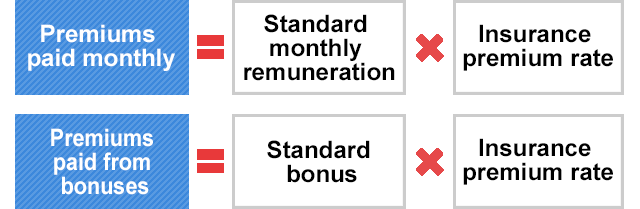
Since the amounts of remuneration received by insured persons are not perfectly uniform and fluctuate from month to month, calculating premiums based on each individual's actual remuneration amount is impractical. For this reason, insurance premiums are calculated based on a standard value (standard monthly remuneration) determined corresponding to a certain ranges of remuneration amounts.
"The standard bonus" is the bonus amount (for these purposes capped at a cumulative annual maximum of 5.73 million yen) rounded down to the nearest 1,000 yen.
The Society's insurance premium rates
| (‰) | Total | Percentage paid by employer | Percentage paid by insured person | |
|---|---|---|---|---|
| General insurance premium rate | aaaa | 88.700 | 45.828 | 42.872 |
| Insurance premium rate | 31.706 | 16.381 | 15.325 | |
| Specific insurance premium rate | 56.994 | 29.447 | 27.547 | |
| Adjusted premium rate | 1.300 | 0.672 | 0.628 | |
| Total Insurance premium rate | 90.000 | 46.500 | 43.500 | |
| (‰) | Total | Percentage paid by employer | Percentage paid by insured person | |
|---|---|---|---|---|
| Child and Childcare Support Contribution rate | 2.300 | 1.150 | 1.150 | |
| (‰) | Total | Percentage paid by employer | Percentage paid by insured person | |
|---|---|---|---|---|
| Long-term care insurance premium rate | 20.000 | 10.000 | 10.000 | |
Types of insurance premiums
Health insurance premiums consist of general insurance premiums, long-term care insurance premiums, and regulation insurance premiums. The amount of each premium is determined by multiplying the standard monthly remuneration and standard bonus by the insurance premium rate for each type of insurance.
In addition, collection of the Child and Childcare Support Contribution will begin with the premiums for April 2026 (payable in May*).
- * For Voluntarily and Continuously Insured Persons, collection will begin with the premiums payable in April 2026.
- Reference link
General insurance premiums (base premiums + specific premiums)
General insurance premiums are generally used to help defray health insurance benefits. They also serve as financial resources for paying the cost of support for medical care for the elderly. To clarify the portion of the premiums that help defray support for the elderly, general insurance premiums are separated into base premiums and specific premiums.
Base premiums: premiums applied to services such as medical care benefits and health activities
Specific premiums: premiums applied to uses such as support payments to the medical care system for the advanced elderly and benefits for persons in the earlier stage of old age
Long-term care insurance premiums
While the long-term care insurance system is run by municipalities nationwide, each medical care insurer is required to collect long-term care insurance premiums from Category 2 insured persons under long-term care insurance (both insured persons and dependents aged 40-64 under medical care insurance). Accordingly, the Health Insurance Society collects long-term care insurance premiums.
Child and Childcare Support Contribution
The Child and Childcare Support Contribution system is a new framework for cooperation and sharing based on the philosophy of social solidarity, under which all generations and economic entities support children and child-rearing households. Health insurance societies will collect the Child and Childcare Support Contribution on behalf of the national government.
The contribution is used exclusively for legally prescribed benefits for children and child-rearing households, such as to enhance child allowances, and is administered under a scheme separate from that for health insurance premiums.
The burden rate (contribution rate) starts at 0.23% in FY2026 and will increase in stages to approximately 0.4% by FY2028. The rate will not continue to increase thereafter because the Japanese government has set FY2028 as the year with the maximum contribution amount.
Regulation insurance premiums
The health insurance societies in Japan jointly operate systems providing joint coverage of high-cost medical expenses and aid for societies facing dire financial circumstances (financial adjustments). Regulation insurance premiums fund these systems.